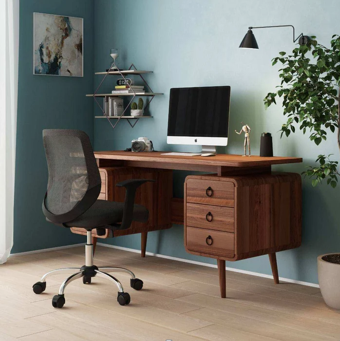
A desk has to do more than look tidy in a photograph. It needs enough surface area for the way you work, space underneath for your legs and a sensible relationship with the rest of the room. In many UK homes, the workstation is also a guest-room corner, landing alcove or part of the sitting room, so a desk that dominates the space can be as troublesome as one that is too small. Before choosing between a slim writing table and a substantial workstation, picture an ordinary working day. Where will the laptop sit? Do you write by hand? Are there cables, files or equipment that need to stay connected? Those answers reveal which features are genuinely worth paying attention to.
DESK INSPIRATION | A workspace with wood tones, task lighting and nearby storage.
Begin With Your Real Working Footprint
Measure the location at its narrowest point, including skirting boards, window recesses and nearby doors. If the desk will face a wall, consider the space required for the chair to move backwards and for someone else to pass behind it. A compact surface may work perfectly for a laptop and notebook, but multiple screens, an external keyboard and regular paperwork change the calculation. Lay out the items you use most on a dining table and measure the working rectangle they occupy.
Check depth as carefully as width. A shallow desk may force the screen uncomfortably close or leave the keyboard hanging over the front edge. Conversely, a very deep desk can overwhelm a small bedroom. If possible, mark the footprint on the floor and place a chair within it before ordering. You will discover quickly whether drawers, table legs or a nearby radiator restrict the position you hoped to use.
See also: Europe Surgery Poland: Exploring Affordable Plastic Surgery Options for International Patients
Decide What Should Live on the Surface
A clear workspace is easier to maintain when every item has an obvious place. Make a short inventory: computer, screen, lamp, daily notebook, stationery, printer and documents. Separate the objects used every hour from those needed only occasionally. The former deserve easy reach; the latter can go into a drawer, a nearby shelf or a closed box. A desk with built-in storage may reduce the need for extra furniture, but large drawer pedestals can consume valuable legroom.
Test the placement of a task lamp and drinks as well as technology. You should not have to move a pile of papers every time you open a laptop. If the room is shared with other activities, a simple tray for current work can help the surface return to domestic use at the end of the day. The ideal desk is not necessarily completely bare; it is organised around repeatable habits.
Compare Surface Materials Without Guesswork
Timber offers warmth and visual variety, but the construction beneath a finish matters. Someone considering an oak desk may be drawn to the natural character of oak tones; nevertheless, check the individual product description to distinguish solid timber, veneer and oak-effect finishes. These are different constructions and should not be treated as interchangeable. Solid wood may show natural movement with humidity, while engineered cores can offer dimensional stability, depending on their quality and assembly.
Whatever the material, examine the stated surface finish and recommended care. A worktop used for writing should feel smooth and even, with edges that are comfortable against the forearms. If you expect to use a monitor arm, confirm the edge profile, thickness and clamping suitability rather than assuming any desktop will accept one. Small practical details often matter more than the name of the wood.
DESK MATERIALS | A glass worktop and curved timber frame offer a different visual finish.
Treat Cable Management as Part of the Design
Cables become a nuisance when they cross walking routes, catch on chair wheels or pull against plugs whenever the desk moves. Plan where the mains socket is located before positioning the furniture. Desk grommets, an under-desk cable tray or removable cable clips can keep connections accessible without bundling them tightly around heat-producing equipment. Leave enough slack for an adjustable chair or screen, and follow electrical safety guidance for power strips and extension leads.
A desk placed near a window benefits from daylight, but bright reflections may make a screen difficult to read. Angling the monitor away from direct glare and using blinds can make the position more workable. A small adjustable lamp is useful for winter afternoons, especially when the rest of the room has softer ambient lighting. Good cable and light planning makes a compact desk feel much more generous.
Look for Proportions That Belong in the Room
A writing desk with slender legs can sit comfortably in a living area, while a larger desk with drawers may make more sense in a dedicated office. Consider repeating an existing timber tone rather than matching every piece exactly. A natural wood surface can soften a white room, and a darker finish can sit well with painted shelving or period details. Handles, leg shapes and the visual weight of storage units influence the overall effect.
If the desk is in a shared room, remember the visual impact of the workspace when the day ends. A shallow drawer, simple laptop stand or a box for stationery can reduce how much equipment remains on show. Some people need to see their tools to stay organised; others prefer everything closed away. Choose a level of storage that reflects that preference, because even an elegant desk becomes inconvenient if the daily clearing-up process is too complicated.
Think also about how long the desk may remain useful. Will there be space for a larger monitor later? Can the furniture be moved to another room without difficulty? Can the surface be cleaned and maintained according to the manufacturer’s instructions? A flexible, well-proportioned desk is often a better long-term choice than one tailored to a very temporary arrangement.
Buy for the Work You Actually Do
Start with measurements and equipment, not the finish. Leave enough working depth, keep essential items accessible and make sensible provision for cables and lighting. Once the functional choices are settled, choose a desk whose materials and proportions feel at home in the room. A productive space does not have to look like a corporate office; it simply needs to make everyday work less awkward.
