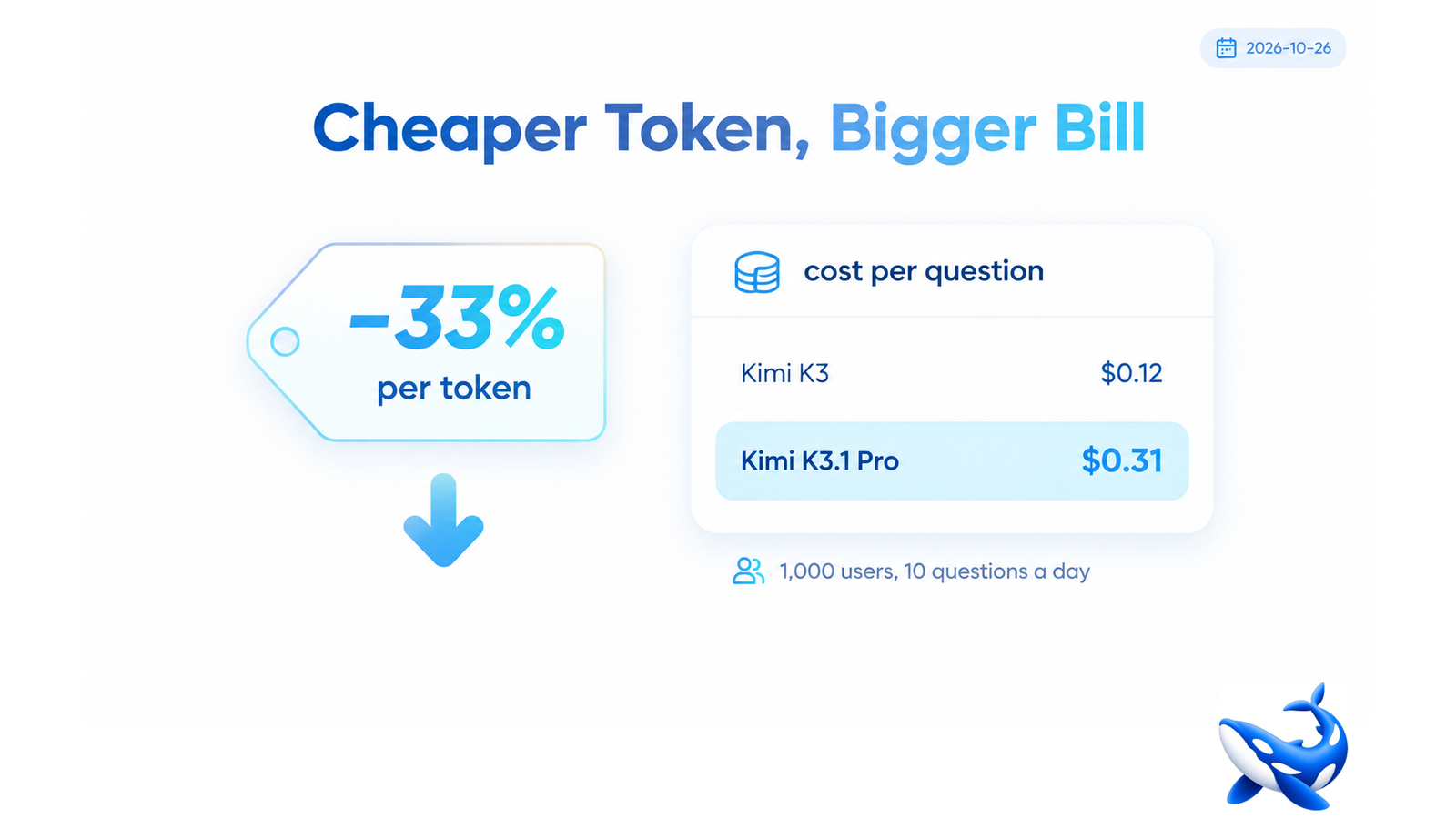
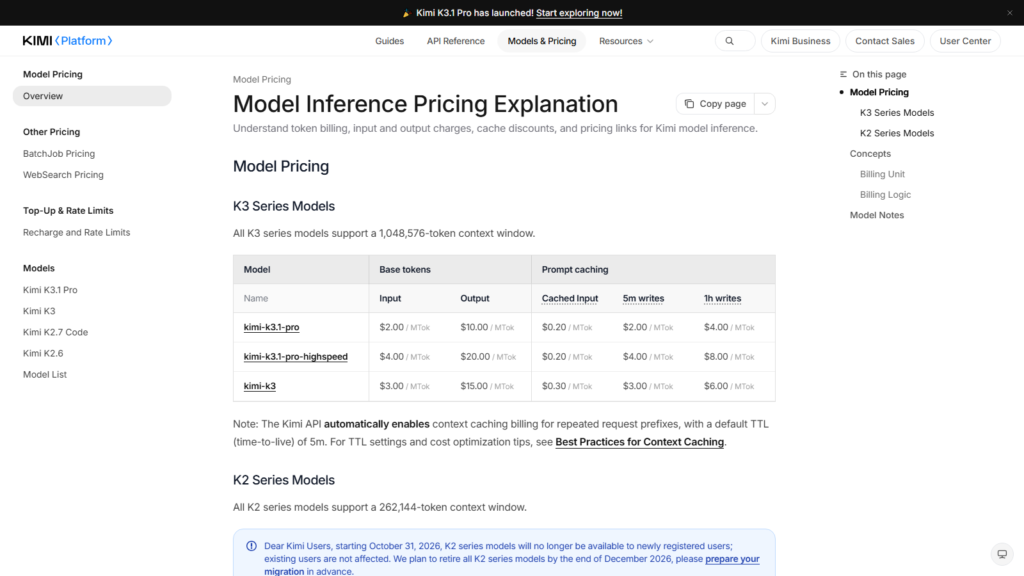
Moonshot cut Kimi K3.1 Pro’s token prices by a third and the marketing writes itself: cheaper input, cheaper output, cheaper cache. Then a data-analytics vendor ran the model through its own 43-question exam and published the bill. Kimi K3.1 Pro cost $13.47 to complete, or $0.31 per question. Its predecessor cost $5.01 for 35 correct answers, or $0.12 per question [INDEPENDENT — Plotly DataAnalyticsBench, one run, 23 October]. The cheaper token bought a bill 2.7 times larger — and on the OrcaRouter pass-through of Kimi K3.1 Pro pricing, $2.00 in, $10.00 out and $0.20 cached, that bill is reproducible from the card rather than taken on trust.
That is not a trick or an error. It is the most important thing to understand about this release, and it is the reason the rate card should be read alongside a token-count column rather than on its own.
The test
Plotly’s benchmark is private, which makes it weaker evidence than a public harness and more interesting than nothing. It is 43 questions over a synthetic wind-farm maintenance warehouse: 20 analytics questions, 5 ambiguous requests, 5 impossible requests, 5 statistics traps, 3 data-quality tasks and 5 hidden-pattern tasks where the answer is a correlation buried in the data rather than a query anyone would write. One run, 34 models on the leaderboard.
Kimi K3.1 Pro scored 42 out of 43, grade A. It found all five hidden patterns, cleared all five impossible requests (correctly refusing rather than inventing), got 4 of 5 statistics traps and 3 out of 3 data-quality tasks. Its predecessor scored 35 out of 43 — including zero of five hidden patterns and one of three data-quality tasks.
So the new model is substantially better at exactly the work the test measures. It is also slower and dearer per question:
| Kimi K3 | Kimi K3.1 Pro | |
| Score | 35/43 (81%) | 42/43 (98%) |
| Cost, full exam | $5.01 | $13.47 |
| Cost per question | $0.117 | $0.31 |
| Median time per question | 43 s | 2.5 min |
| Hidden patterns found | 0 / 5 | 5 / 5 |
| Data-quality tasks | 1 / 3 | 3 / 3 |
Where the money went
The test’s own telemetry explains the bill in three numbers, and each is a property of how this model works rather than how it is priced.
Seven and a half model calls per question. The model does not answer in one shot; it plans, queries, checks, queries again. Each call re-sends context, so the per-question token count is a multiple of the per-call token count.
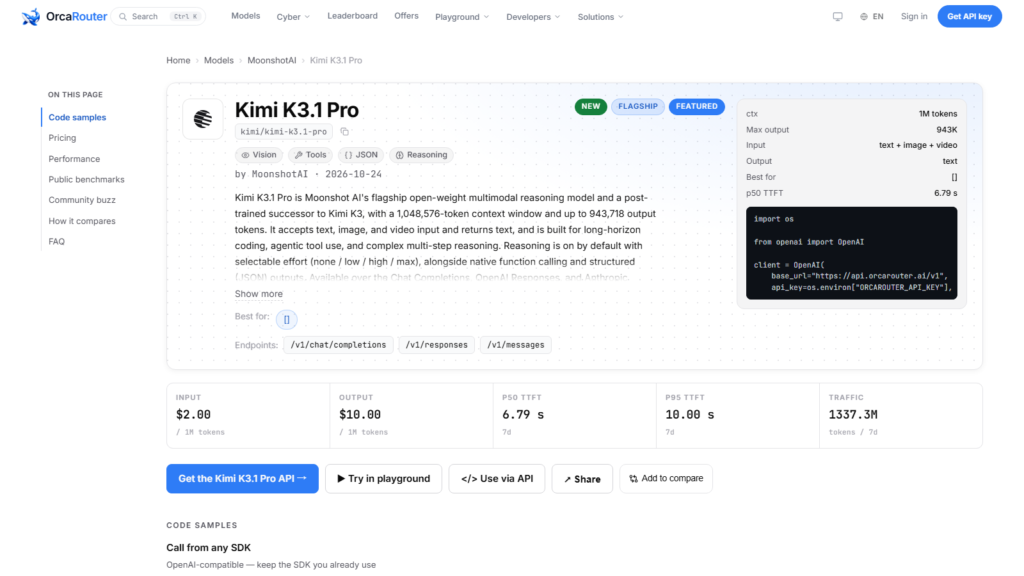
About 440,000 input tokens per question, 92% of them cache hits. At $2.00 per million input and $0.20 per million cached, that is roughly $0.09 of input per question — and the 92% hit rate is what keeps it at nine cents rather than 88. A model that reads four hundred thousand tokens per question is only viable because caching is automatic and cheap. This is the clearest real-world evidence for why the cache-read line matters more than the input line on this model.
About 16,500 output tokens per question, 62% of them reasoning. Output is billed at $10.00 per million, and output accounted for $7.10 of the $13.47 total. Thinking is more than half the output; output is more than half the bill.
Put together: the model is cheap per token because the vendor cut the rates, and expensive per question because the model spends a lot of tokens doing the work. Both halves are deliberate. Kimi K3.1 Pro is built to take seven swings at a task and check itself, and that behaviour is precisely what took hidden-pattern detection from zero to five.
See also: Powering Next-Gen Electric Vehicles with Cutting-Edge Tech
The scale number that matters more than the exam
The benchmark authors did the arithmetic most coverage skipped: at $2.00/$10.00/$0.20, 1,000 users asking 10 questions a day would cost about $780 per user per year, against about $290 on Kimi K3.
That is the number a finance team should see before a migration. A 33% rate cut plus a 2.7× volume increase is a 1.8× cost increase per user at this workload shape, and the increase is concentrated in the two places the model deliberately spends: tool calls and reasoning tokens.
It also reframes the comparison with the models that beat it. GPT-6.1 Sol finished the same 43 questions without a miss at $2.61 — a fifth of Kimi’s bill — and GPT-6 Astra also went 43 for 43 [INDEPENDENT]. Grok 4.7 tied Kimi at 42/43 for $7.85. On score, Kimi is in a four-way tie at the top. On cost per correct answer, it is third of four.
What this benchmark does and does not prove
It proves the capability claim in a domain that matters. Analytics over a messy warehouse with ambiguous and impossible requests is what enterprise data work looks like, and 98% with five-for-five on hidden patterns is a strong result from any lab. The one miss is instructive rather than damning: the model computed a group average correctly but misclassified 2,775 turbine-days as “other firmware” when no other firmware existed, moving an average by 0.0003 — just outside tolerance. That is a real, small reasoning slip on a real kind of question.
It does not prove reproducibility. One run, a private exam and synthetic data. The authors say so themselves and invite you to build your own. Treat the ranking as a signal about behaviour and the cost as a signal about token consumption; neither is a settled measurement.
It says nothing about the fast SKU. Moonshot sells a Highspeed variant at double the rates and two to three times the speed [VENDOR]; the test used the standard model. Since this benchmark’s bottleneck is elapsed time — 2.5 minutes per question, second slowest of 34 models — the fast SKU is arguably the right comparison for a production deployment, and nobody has published its score.
The practical read
For a workload where one wrong answer costs more than one right answer saves, Kimi K3.1 Pro’s 98% at $0.31 a question is a bargain — cheaper than a human analyst by three orders of magnitude and more accurate than the previous generation on exactly the hard cases. Migrate, and budget for a larger bill than the rate cut implies.
For a workload where volume is the point — ten thousand straightforward queries a day — the model’s insistence on seven tool calls and sixteen thousand output tokens per question is a tax you are paying for accuracy you may not need. GPT-6.1 Sol matched the score at a fifth of the cost on this test; the honest options are to route the easy traffic to a cheaper model and the hard traffic here, or to cap effort and output per request and accept a lower score.
Either way, do the thing the benchmark authors did: measure cost per correct answer on your own traffic before you sign off on a migration, and count tokens, not rates. A third off the token is not a third off the bill, and on this model it can be the opposite.
Sourcing note: the 43-question exam, its category breakdown, the dollar figures, the token telemetry, the scale estimate and every competitor score in this article are Plotly’s own published measurements from a private, single-run benchmark on synthetic data, dated 23 October 2026 — independent of Moonshot but not independently reproducible. The rate card is Moonshot’s. The predecessor comparison is within the same benchmark. The fast-SKU note is Moonshot’s product line, which we do not carry.
